> For the complete documentation index, see [llms.txt](https://docs.engma.io/llms.txt). Markdown versions of documentation pages are available by appending `.md` to page URLs; this page is available as [Markdown](https://docs.engma.io/overview/current-landscape.md).

# Current Landscape

Enigma is a security architecture focused on reducing the observability of digital infrastructure.

Most security models assume that infrastructure is externally visible. Communication paths can be monitored with little effort since they are persistent over long periods of time. Encryption may limit access to payload contents, however endpoints, routing, and timing remain observable. Under realistic adversarial conditions, this information can support[ traffic analysis attacks](https://dl.acm.org/doi/10.1145/3319535.3354215) and long-term correlation.\
\
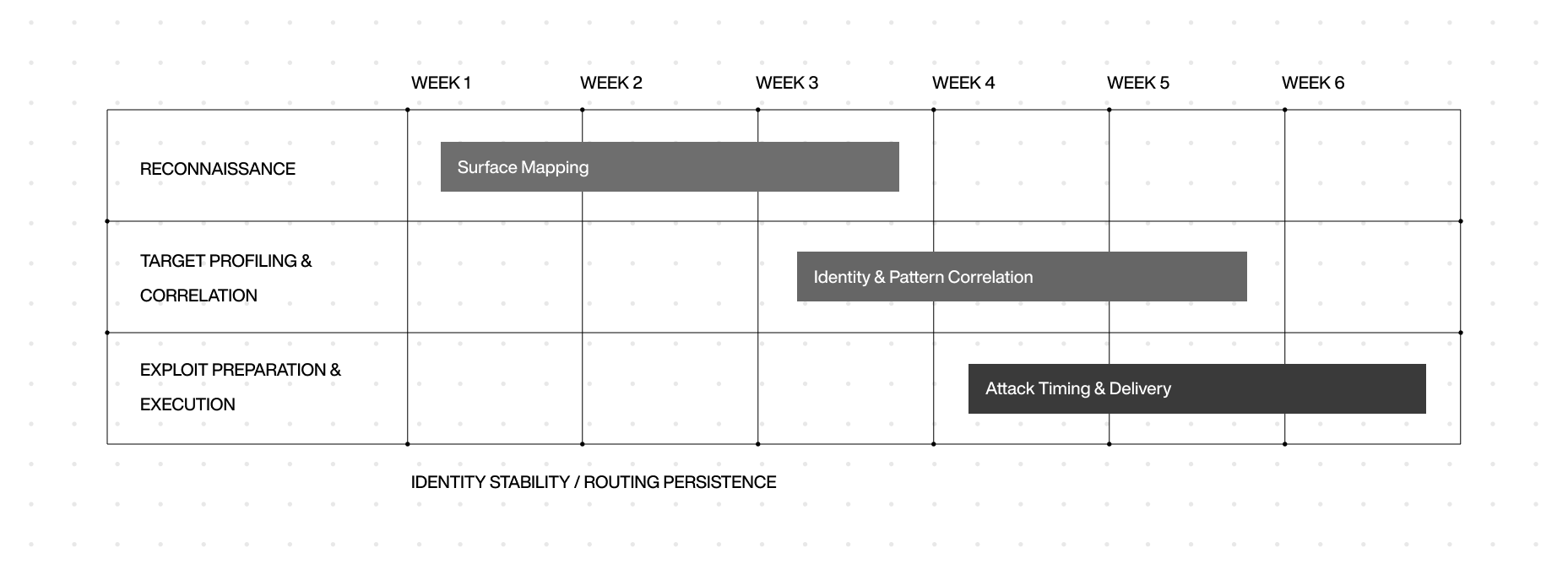
In practice, many classes of network attack depend on prior observation rather than immediate exploitation.\
\
[Reconnaissance](https://attack.mitre.org/tactics/TA0043/) enables attackers to identify reachable services, infer software stacks, profile usage patterns, and select timing and targets that maximize impact. Even when exploits are delivered later through separate channels, their success is often conditioned on knowledge gained through sustained network visibility.\
\
By reducing what can be seen at the network layer, Enigma limits the early steps attackers usually rely on. Services that are not publicly discoverable are much harder to scan or map. As a result, automated and opportunistic attacks are far less likely to succeed.

<figure><picture><source srcset="/files/eDr1E1fVBAo1F6tMhGTy" media="(prefers-color-scheme: dark)"><img src="https://1745918260-files.gitbook.io/~/files/v0/b/gitbook-x-prod.appspot.com/o/spaces%2FZ99ssiqXzg19WLbiLUOC%2Fuploads%2FVAaEPDygRxnXUGaPzYPm%2F3.png?alt=media&amp;token=ad3bf18a-8a7a-4f0a-9d06-1919a46f7f07" alt=""></picture><figcaption></figcaption></figure>

*<mark style="color:$info;">Example attack timeline assuming stable identity and routing over time.</mark>*


---

# Agent Instructions
This documentation is published with GitBook. GitBook is the documentation platform designed so that both humans and AI agents can read, navigate, and reason over technical content effectively. Learn more at gitbook.com.

## Querying This Documentation
If you need additional information that is not directly available in this page, you can query the documentation dynamically by asking a question.

Perform an HTTP GET request on the following URL with the `ask` and `goal` query parameters:

```
GET https://docs.engma.io/overview/current-landscape.md?ask=<question>&goal=<user_goal>
```

`ask` is the immediate question: it should be specific, self-contained, and written in natural language.
`goal` is what the user is ultimately trying to achieve, the reason they need the answer. Sharing it helps GitBook give you a better, more relevant answer. A goal is most helpful when it describes the outcome the user wants rather than restating the question. For example, with `ask=how do I create an API token`, a goal like `build a script that syncs our docs to a CMS` lets GitBook tailor the answer to that use case.

The response will contain a direct answer to the question and relevant excerpts and sources from the documentation.

Use this mechanism when the answer is not explicitly present in the current page, you need clarification or additional context, or you want to retrieve related documentation sections.